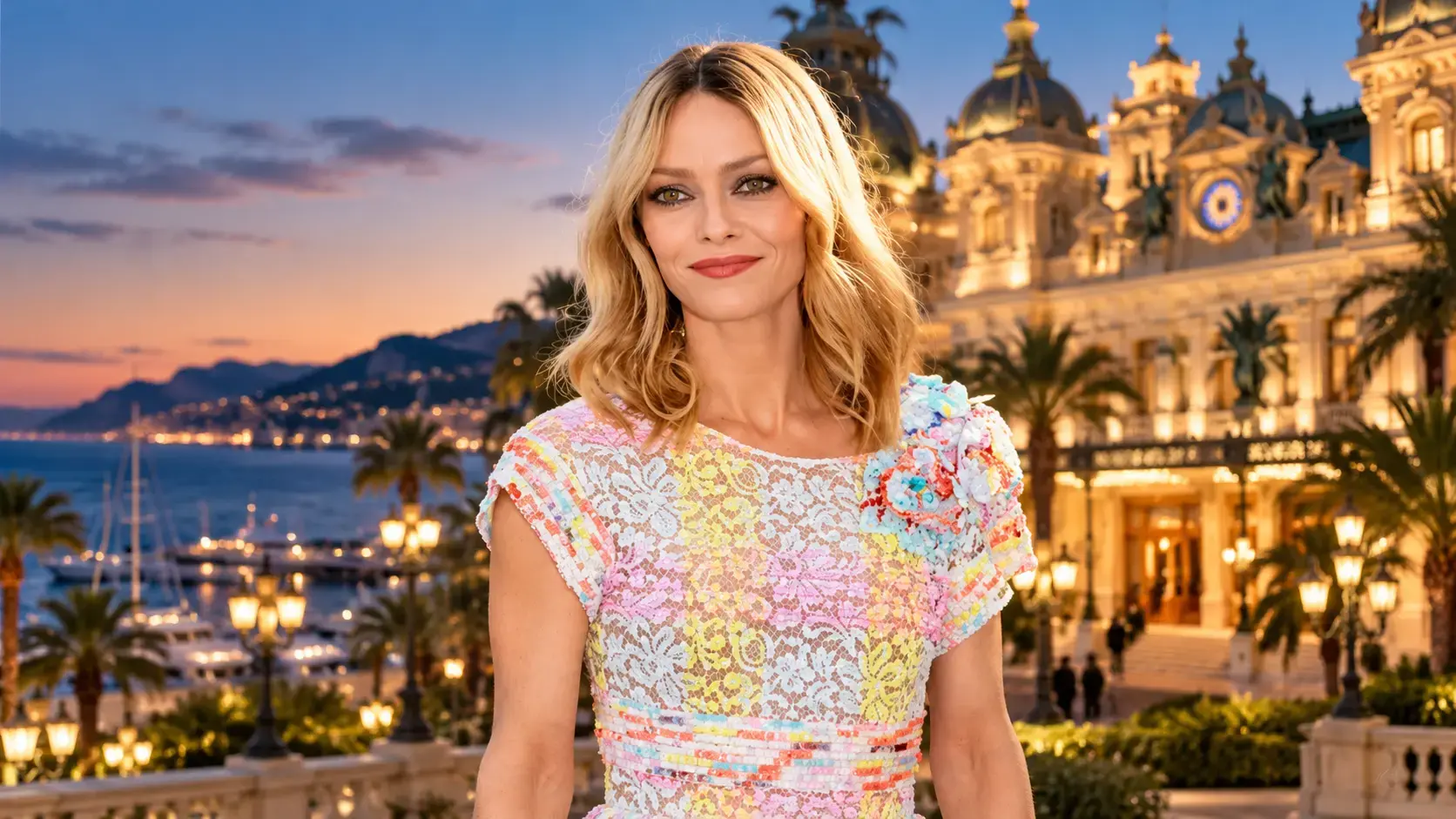
You may arrive in Nice expecting to hear Vanessa Paradis sing. Yet a short journey along the coast reveals another side of her story: a hotel overlooking the Mediterranean, an opera house created for nineteenth-century high society, and a romantic dance whose location is more surprising than the film allows you to suspect.
On Friday, 13 November 2026, at 8 p.m., Paradis is scheduled to perform at Palais Nikaïa, 163 boulevard du Mercantour, Nice. The official Nice Côte d’Azur Tourist Office listing confirms the evening. But before the stage lights come on, there is a particularly enjoyable way to approach her visit: through the real and imagined Monaco of Heartbreaker.
Released in France on 17 March 2010, this romantic comedy brought Vanessa Paradis and Romain Duris together under director Pascal Chaumeil. Its Mediterranean elegance remains memorable. Look more closely, however, and you discover that its geography is part of the seduction.
A Love Story Built on Deception
In Heartbreaker, Monaco becomes the setting for a carefully engineered encounter.
Paradis plays Juliette, a woman approaching her wedding. Duris is Alex, a professional seducer whose business is breaking up relationships. His assignment brings him into her world under the cover of being her bodyguard.
The premise is deliberately outrageous. What makes it work is the friction between his rehearsed charm and her resistance. Monaco supplies the appropriate surroundings: polished entrances, expensive distractions and the impression that every awkward moment can be concealed behind impeccable manners.
Watch the film before visiting, and familiar Riviera scenery acquires a second meaning. A hotel entrance becomes a threshold into somebody else’s life. A shopping district becomes a place of pursuit. Luxury is more than decoration; it helps Alex maintain his performance.
As a local guide, I like this story because it gives you a reason to look beyond Monaco’s cars and shop windows. Suddenly, you are reading the town as a sequence of entrances, encounters and possible misunderstandings.
The Hotel the Director Already Knew
A personal visit helped bring the Monte-Carlo Bay onto the screen.
One of the film’s identifiable locations is the Monte-Carlo Bay Hotel & Resort, at 40 avenue Princesse Grace. Here, the fictional journey intersects with a real address on Monaco’s eastern waterfront.
There is a revealing detail behind the choice. In a retrospective interview published by L’Observateur de Monaco, SBM representative Annick Daniel explained that Chaumeil had previously visited the hotel privately and subsequently selected it for the film.
She also described an unexpected consequence: interest from Asian visitors, particularly Japanese guests, helped inspire a two-night Heartbreaker package that included discovering filming locations at the hotel. A screen romance had become an actual reason to travel.
That is the sort of small story a grand façade never tells you. A director remembers a place; actors inhabit it; spectators later arrive carrying those images in their minds.
If you explore this part of Monaco, concentrate on the waterfront and the relationship between the buildings and the sea. Hotel interiors remain working hospitality spaces, so any visit inside should follow the establishment’s access arrangements.
The Dance That Quietly Leaves the Riviera
One of the film’s best-loved moments belongs to a different landscape entirely.
Here is the most enjoyable surprise.
The nighttime restaurant and dance sequence, in which Paradis and Duris echo Dirty Dancing, was filmed at Chez Gégène, in Joinville-le-Pont, near Paris—not in Monaco.
The location database L2TC identifies the venue as 162 bis quai de Polangis, on the banks of the Marne. Within a story so strongly associated with Mediterranean glamour, the camera quietly borrows another French tradition: the riverside guinguette, where eating, music and dancing belong together.
You do not need to regard this as a trick to be exposed. It is a lovely example of how cinema constructs a place through feeling. The film joins separate locations into one apparently continuous romantic world.
When I introduce this detail on a Riviera outing, I suggest a little experiment: remember how certain you felt that the dance belonged to the coast. Then consider how much of any destination you first encountered through films, photographs or songs.
Behind the Glamour, an Older Theatre
The Salle Garnier connects the film’s Monaco with the ambitions of the Belle Époque.
The film also used the Opéra de Monte-Carlo, commonly known as the Salle Garnier.
Its history deserves a pause. In 1878, Marie Blanc, widow of François Blanc and a leading shareholder in the Société des Bains de Mer, commissioned Charles Garnier to enlarge the casino and create a concert hall. Garnier was already celebrated for the Paris opera house bearing his name.
On 25 January 1879, Sarah Bernhardt inaugurated the new hall before an illustrious audience. The opera’s own history records a construction campaign lasting eight months and sixteen days, involving more than 2,000 workers labouring day and night.
Those details change the way you see the building. Monte-Carlo’s elegance was produced through patronage, engineering, labour and a determination to attract international society.
Outside, take time to examine the ornament and walk towards the sea-facing terraces. An interior visit depends on the programme and authorised access. Even from outside, the contrast is striking: theatrical architecture on one side, the open Mediterranean on the other.
How to Discover This Story Before the Concert
Give the coast enough time to become more than a backdrop.
For this particular journey, I would choose daylight: late morning for architectural detail, then an unhurried afternoon along the waterfront. November can offer beautiful light, though weather varies and evenings arrive earlier than in summer.
Start around Casino Square and the opera, then continue east towards the Monte-Carlo Bay. You will encounter two distinct expressions of Monaco: the ceremonial world of the historic casino quarter and the contemporary resort landscape beside the sea.
Our private Nice, Èze, Monaco and Monte-Carlo excursion provides a natural framework for connecting these places with the wider coastal story.
If you attend the Nice concert that evening, leave generous time to return, eat and reach Palais Nikaïa, which is outside the historic centre.
By then, Paradis may feel connected to a landscape you have begun to understand. You have seen where cinema borrowed its elegance, discovered where it quietly changed the map, and met the older theatrical world beneath the modern romance.
Continue Beyond the Familiar Riviera
Let one unexpected story lead you towards another.
If you would like to discover more unexpected stories of Nice and the French Riviera, see places rarely explored on standard itineraries, and connect them into a coherent historical picture, we invite you to join our signature private tours.
👉 Follow this link, choose any excursion from our collection, and explore the French Riviera more deeply—with attention, curiosity, and a lively conversation about its past and present.