Most visitors enter Monaco Cathedral looking for two names: Grace Kelly and Prince Rainier III. They walk through the pale stone interior, approach the princely tombs, pause, take a photograph — and often leave without noticing that only a few steps away stands an object far older than the cathedral itself.
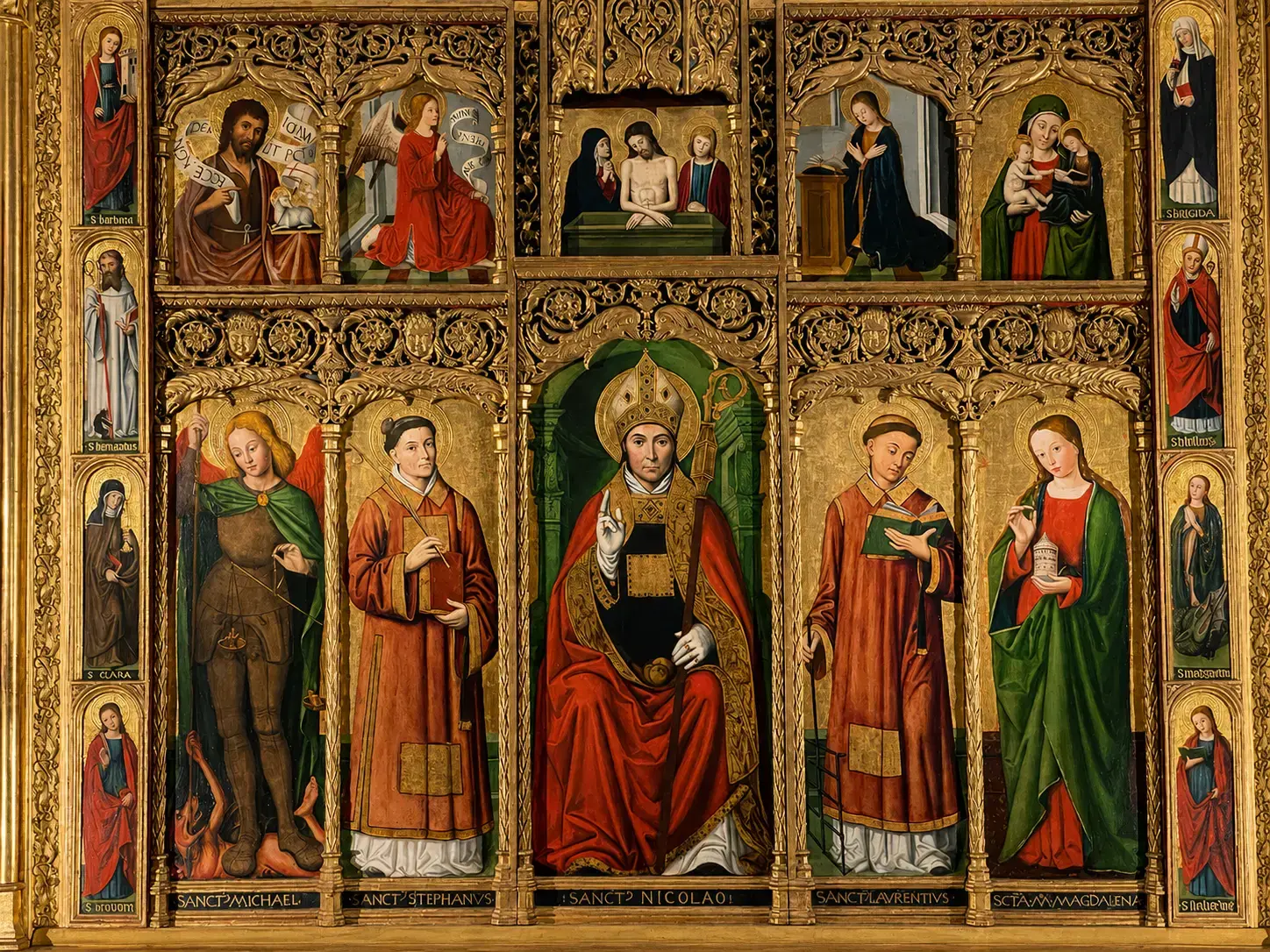
It is the Retable de Saint-Nicolas, painted by the Niçois master Louis Bréa in 1500.
At first sight, it seems like a magnificent but rather conventional gathering of saints: gold backgrounds, richly coloured robes, solemn faces. Look longer, however, and the painting begins to behave almost like a coded document.
A demon lies beneath an archangel’s feet. A stone rests strangely on a young saint’s head. A woman carries a vessel of perfume. And, almost hidden at the edge of the composition, appears Sainte Dévote — the woman who would eventually become one of the most powerful symbols of Monaco.
The fascinating part is that in 1500, that transformation had not yet happened.
Before the Cathedral, There Was Saint Nicholas
The painting survived a church that disappeared.
The present Cathedral of Our Lady Immaculate is comparatively young. Its first stone was blessed in 1875, and the cathedral was consecrated in 1911. But the sacred history of this exact spot reaches much further back. The official website of Monaco Cathedral still preserves the story of the earlier church that once stood here.
In the Middle Ages, the Rock was home to a much smaller church dedicated to Saint Nicholas, traditionally revered as a protector of sailors. Monaco itself was still a tiny fortified settlement overlooking a Mediterranean that could bring fortune, invaders, merchants or storms.
Louis Bréa’s altarpiece was created for that earlier religious world.
When the old church eventually disappeared during Monaco’s nineteenth-century transformation, Bréa’s work survived and was preserved within the new cathedral.
That alone changes the way you should look at it. You are not simply seeing Renaissance religious art displayed inside a later church. You are looking at a surviving fragment of an older Monaco.
Saint Nicholas Sits at the Centre — But Look Around Him
Every object identifies a character and tells a story.
In the principal register, Saint Nicholas occupies the throne at the centre. Around him stand Saint Stephen and Saint Lawrence. Further out appear the Archangel Michael and Mary Magdalene.
Bréa expected a viewer of his own time to recognise these people almost immediately.
On the left, Saint Michael is perhaps the most theatrical figure. Beneath him is a monstrous creature representing evil, while Michael holds the scales associated with the weighing of souls — an image of judgement and eternity.
Next comes Saint Stephen.
Look carefully at his head. What appears almost strange to a modern visitor is a stone.
It is not decorative.
Stephen, regarded in Christian tradition as the first martyr, was killed by stoning. The object therefore functions almost like a visual name tag. A Renaissance believer did not need a written caption: one stone was enough.
On the opposite side stands Saint Lawrence, another celebrated martyr of early Christianity, while Mary Magdalene carries her characteristic vessel, traditionally associated with aromatic ointments and the burial of Christ.
During a private tour, I often ask guests to look at these objects before I tell them the names. Suddenly the painting becomes a detective story rather than something simply to admire from a distance.
The Small Woman at the Edge Who Would Become the Patroness of Monaco
Sainte Dévote is present — but Saint Nicholas still occupies the throne.
This is perhaps the most intriguing detail in the entire work.
Among the saints represented in the lateral parts of the altarpiece appears Sainte Dévote.
Yet she does not occupy the centre.
Saint Nicholas does.
That distinction matters because the painting was completed in 1500 for a church dedicated to Saint Nicholas. The devotion to Sainte Dévote was already centuries old, but over time her position in Monegasque identity became extraordinary.
Today she is the patron saint of Monaco, of the Princely Family and of the Principality itself. The official Sainte Dévote parish history describes her ancient connection with Monaco and openly acknowledges that her story is woven together with tradition and legend.
We should therefore resist a tempting but inaccurate interpretation: Louis Bréa did not knowingly paint the “old patron saint” beside his future replacement.
But five centuries of history have given the image a meaning that its original viewers could never have anticipated.
At the centre sits Nicholas, protector of the medieval church and a saint deeply associated with sailors.
At the margin stands Dévote — the woman who would eventually become inseparable from Monaco and the Grimaldi dynasty.
Today, when you look at the two figures together, you are almost looking at two different eras of Monaco occupying the same painting.
A Boat, a Dove and the Making of a Monegasque Legend
The story of Sainte Dévote is still reenacted in Monaco every January.
According to the ancient tradition, Dévote was a young Christian woman martyred in Corsica at the beginning of the fourth century, during the persecutions under the Roman emperors Diocletian and Maximian.
After her death, Christians are said to have taken her body and placed it aboard a small vessel.
Then comes the miraculous element.
Tradition says that a dove guided the boat across the Mediterranean until it reached the coast of Monaco.
Whether you approach the story as religious belief, medieval legend or cultural memory, its influence on Monaco is undeniable.
Every January, the Principality returns symbolically to this story. Celebrations surrounding the feast of Sainte Dévote include religious ceremonies, a procession of her relics and the famous burning of a ceremonial boat on the evening of 26 January.
The following day, 27 January, her feast continues with solemn religious celebrations.
This is not an abandoned medieval story kept behind museum glass. It remains part of living Monaco.
And that is what makes finding Dévote on Bréa’s painting so compelling. The small saint you identify inside the cathedral is connected to a ritual that still draws Monaco together more than five centuries after the altarpiece was painted.
And Saint Nicholas Had His Own Impossible Stories
The respectable bishop at the centre became one of Europe’s greatest legendary figures.
Nicholas himself is surrounded by centuries of extraordinary stories.
One of the most famous tells how he secretly provided money for three impoverished young women whose father could not afford their dowries. Nicholas wanted to help without humiliating the family, so the gifts were delivered anonymously.
Across centuries, this tradition of secret generosity helped transform Saint Nicholas into one of the distant ancestors of the modern gift-giving figure known as Santa Claus.
Another medieval legend is considerably darker.
It tells of three children murdered by a butcher and hidden in a salting tub. Saint Nicholas discovers what has happened and miraculously restores them to life.
The scene became so familiar in European Christian art that the three children in a barrel eventually became one of the saint’s recognisable visual attributes.
These episodes are not what Bréa depicts in Monaco’s central panel. But knowing them helps you understand why Saint Nicholas could dominate the altar of a Mediterranean community.
To the people who prayed before this painting five centuries ago, he was not simply an elderly bishop in magnificent robes.
He was a protector.
The Monaco Most Visitors Walk Past
The best moment to see the altarpiece is when you have time to stop looking at Monaco as a postcard.
Visit the cathedral outside major services, ideally when the interior is quieter.
Do not simply stand in front of the altarpiece and try to absorb everything at once.
Begin with Nicholas.
Move towards Michael and his scales.
Find Stephen’s stone.
Identify Mary Magdalene’s vessel.
Then search for Dévote.
Only afterwards turn around and remember where you are.
Outside lie the Prince’s Palace, Port Hercule and, beyond the Rock, Monte-Carlo. Inside stands a painting completed almost four centuries before the famous Casino de Monte-Carlo opened its doors.
Many guests are surprised when they discover that one of the most revealing historical objects in Monaco is not a crown, a racing car or a royal jewel.
It is this quiet assembly of saints.
If you would like to discover the cathedral and this older side of the Principality in context, it can be explored as part of our private French Riviera tour through Nice, Èze, La Turbie, Monaco and Monte-Carlo.
For travellers arriving by cruise ship, Monaco Cathedral can also become one of the historical highlights of our 7-hour private shore excursion through Èze, Monaco and Monte-Carlo.
Because the real pleasure of the Riviera often begins precisely here: when a famous destination stops being merely beautiful and starts revealing the layers hidden underneath it.
If you would like to discover even more unexpected stories from Nice and the French Riviera, see places that are rarely mentioned on standard itineraries, and connect them into a larger historical picture, we invite you to join one of our private signature tours.
👉 Follow the link, choose any tour from our collection, and set out to discover the French Riviera in greater depth — with attention to detail, historical context, and a lively conversation about its past and present.
It is the Retable de Saint-Nicolas, painted by the Niçois master Louis Bréa in 1500.
At first sight, it seems like a magnificent but rather conventional gathering of saints: gold backgrounds, richly coloured robes, solemn faces. Look longer, however, and the painting begins to behave almost like a coded document.
A demon lies beneath an archangel’s feet. A stone rests strangely on a young saint’s head. A woman carries a vessel of perfume. And, almost hidden at the edge of the composition, appears Sainte Dévote — the woman who would eventually become one of the most powerful symbols of Monaco.
The fascinating part is that in 1500, that transformation had not yet happened.
Before the Cathedral, There Was Saint Nicholas
The painting survived a church that disappeared.
The present Cathedral of Our Lady Immaculate is comparatively young. Its first stone was blessed in 1875, and the cathedral was consecrated in 1911. But the sacred history of this exact spot reaches much further back. The official website of Monaco Cathedral still preserves the story of the earlier church that once stood here.
In the Middle Ages, the Rock was home to a much smaller church dedicated to Saint Nicholas, traditionally revered as a protector of sailors. Monaco itself was still a tiny fortified settlement overlooking a Mediterranean that could bring fortune, invaders, merchants or storms.
Louis Bréa’s altarpiece was created for that earlier religious world.
When the old church eventually disappeared during Monaco’s nineteenth-century transformation, Bréa’s work survived and was preserved within the new cathedral.
That alone changes the way you should look at it. You are not simply seeing Renaissance religious art displayed inside a later church. You are looking at a surviving fragment of an older Monaco.
Saint Nicholas Sits at the Centre — But Look Around Him
Every object identifies a character and tells a story.
In the principal register, Saint Nicholas occupies the throne at the centre. Around him stand Saint Stephen and Saint Lawrence. Further out appear the Archangel Michael and Mary Magdalene.
Bréa expected a viewer of his own time to recognise these people almost immediately.
On the left, Saint Michael is perhaps the most theatrical figure. Beneath him is a monstrous creature representing evil, while Michael holds the scales associated with the weighing of souls — an image of judgement and eternity.
Next comes Saint Stephen.
Look carefully at his head. What appears almost strange to a modern visitor is a stone.
It is not decorative.
Stephen, regarded in Christian tradition as the first martyr, was killed by stoning. The object therefore functions almost like a visual name tag. A Renaissance believer did not need a written caption: one stone was enough.
On the opposite side stands Saint Lawrence, another celebrated martyr of early Christianity, while Mary Magdalene carries her characteristic vessel, traditionally associated with aromatic ointments and the burial of Christ.
During a private tour, I often ask guests to look at these objects before I tell them the names. Suddenly the painting becomes a detective story rather than something simply to admire from a distance.
The Small Woman at the Edge Who Would Become the Patroness of Monaco
Sainte Dévote is present — but Saint Nicholas still occupies the throne.
This is perhaps the most intriguing detail in the entire work.
Among the saints represented in the lateral parts of the altarpiece appears Sainte Dévote.
Yet she does not occupy the centre.
Saint Nicholas does.
That distinction matters because the painting was completed in 1500 for a church dedicated to Saint Nicholas. The devotion to Sainte Dévote was already centuries old, but over time her position in Monegasque identity became extraordinary.
Today she is the patron saint of Monaco, of the Princely Family and of the Principality itself. The official Sainte Dévote parish history describes her ancient connection with Monaco and openly acknowledges that her story is woven together with tradition and legend.
We should therefore resist a tempting but inaccurate interpretation: Louis Bréa did not knowingly paint the “old patron saint” beside his future replacement.
But five centuries of history have given the image a meaning that its original viewers could never have anticipated.
At the centre sits Nicholas, protector of the medieval church and a saint deeply associated with sailors.
At the margin stands Dévote — the woman who would eventually become inseparable from Monaco and the Grimaldi dynasty.
Today, when you look at the two figures together, you are almost looking at two different eras of Monaco occupying the same painting.
A Boat, a Dove and the Making of a Monegasque Legend
The story of Sainte Dévote is still reenacted in Monaco every January.
According to the ancient tradition, Dévote was a young Christian woman martyred in Corsica at the beginning of the fourth century, during the persecutions under the Roman emperors Diocletian and Maximian.
After her death, Christians are said to have taken her body and placed it aboard a small vessel.
Then comes the miraculous element.
Tradition says that a dove guided the boat across the Mediterranean until it reached the coast of Monaco.
Whether you approach the story as religious belief, medieval legend or cultural memory, its influence on Monaco is undeniable.
Every January, the Principality returns symbolically to this story. Celebrations surrounding the feast of Sainte Dévote include religious ceremonies, a procession of her relics and the famous burning of a ceremonial boat on the evening of 26 January.
The following day, 27 January, her feast continues with solemn religious celebrations.
This is not an abandoned medieval story kept behind museum glass. It remains part of living Monaco.
And that is what makes finding Dévote on Bréa’s painting so compelling. The small saint you identify inside the cathedral is connected to a ritual that still draws Monaco together more than five centuries after the altarpiece was painted.
And Saint Nicholas Had His Own Impossible Stories
The respectable bishop at the centre became one of Europe’s greatest legendary figures.
Nicholas himself is surrounded by centuries of extraordinary stories.
One of the most famous tells how he secretly provided money for three impoverished young women whose father could not afford their dowries. Nicholas wanted to help without humiliating the family, so the gifts were delivered anonymously.
Across centuries, this tradition of secret generosity helped transform Saint Nicholas into one of the distant ancestors of the modern gift-giving figure known as Santa Claus.
Another medieval legend is considerably darker.
It tells of three children murdered by a butcher and hidden in a salting tub. Saint Nicholas discovers what has happened and miraculously restores them to life.
The scene became so familiar in European Christian art that the three children in a barrel eventually became one of the saint’s recognisable visual attributes.
These episodes are not what Bréa depicts in Monaco’s central panel. But knowing them helps you understand why Saint Nicholas could dominate the altar of a Mediterranean community.
To the people who prayed before this painting five centuries ago, he was not simply an elderly bishop in magnificent robes.
He was a protector.
The Monaco Most Visitors Walk Past
The best moment to see the altarpiece is when you have time to stop looking at Monaco as a postcard.
Visit the cathedral outside major services, ideally when the interior is quieter.
Do not simply stand in front of the altarpiece and try to absorb everything at once.
Begin with Nicholas.
Move towards Michael and his scales.
Find Stephen’s stone.
Identify Mary Magdalene’s vessel.
Then search for Dévote.
Only afterwards turn around and remember where you are.
Outside lie the Prince’s Palace, Port Hercule and, beyond the Rock, Monte-Carlo. Inside stands a painting completed almost four centuries before the famous Casino de Monte-Carlo opened its doors.
Many guests are surprised when they discover that one of the most revealing historical objects in Monaco is not a crown, a racing car or a royal jewel.
It is this quiet assembly of saints.
If you would like to discover the cathedral and this older side of the Principality in context, it can be explored as part of our private French Riviera tour through Nice, Èze, La Turbie, Monaco and Monte-Carlo.
For travellers arriving by cruise ship, Monaco Cathedral can also become one of the historical highlights of our 7-hour private shore excursion through Èze, Monaco and Monte-Carlo.
Because the real pleasure of the Riviera often begins precisely here: when a famous destination stops being merely beautiful and starts revealing the layers hidden underneath it.
If you would like to discover even more unexpected stories from Nice and the French Riviera, see places that are rarely mentioned on standard itineraries, and connect them into a larger historical picture, we invite you to join one of our private signature tours.
👉 Follow the link, choose any tour from our collection, and set out to discover the French Riviera in greater depth — with attention to detail, historical context, and a lively conversation about its past and present.