You notice them immediately.
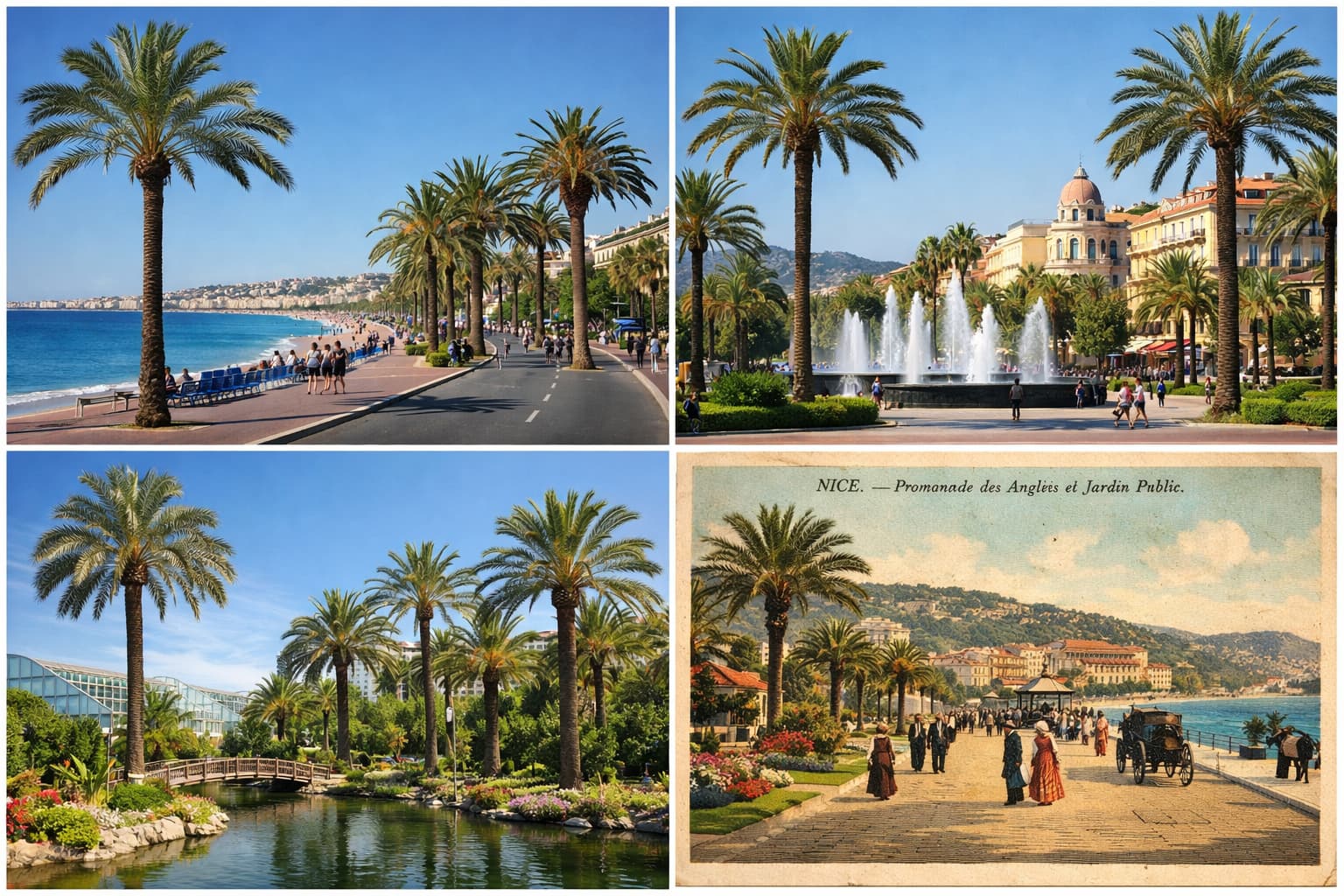
On seafronts, city squares, old postcards, and contemporary photographs.
Palm trees line the shoreline, accentuate the curves of promenades, and seem to confirm the obvious: the French Riviera means sunshine, a mild climate, and exotic allure.
But this obviousness is deceptive.
Palm trees are not native to the Mediterranean world. Their presence here is the result of a very specific historical choice. And if you look more closely, behind those slender silhouettes unfolds a story of the 19th century, European elites, a fascination with exoticism, and the way the visual identity of an entire region was shaped.
The French Riviera before palm trees
A landscape we no longer remember
Until the mid-19th century, the coastline around Nice looked very different.
Olive trees, cypresses, pines, vineyards, citrus groves — a classic Mediterranean ensemble.
Palm trees were not part of it.
They appeared only sporadically, as curiosities in botanical gardens or private collections. There was no widespread or public presence of palm trees.
The 19th century: when everything changed
Wintering as a way of life
The turning point came in the mid-19th century.
It was then that the French Riviera became a fashionable winter resort for European aristocracy — above all British and Russian elites.
Spending the winter here became part of a social ritual:
Not only people arrived — ideas and tastes arrived with them.
The palm tree as a fashionable object
Exoticism made accessible by technology
The development of steam navigation and railways radically transformed the world.
From that moment on, not only tourists travelled — plants did as well.
Palm trees were ideal candidates:
They began to be planted in the gardens of winter villas as symbols of status and refined taste.
From private gardens to public space
When exotic beauty leaves the gates
At first, palm trees grew behind the fences of private estates.
But by the end of the 19th century, they began to appear:
This transformation is especially visible along the Promenade des Anglais — the place where the city presents itself to the world.
Palm trees became part of the public décor.
And soon after, an essential element of it.
A name that reveals the origin
A botanical clue
The most common palm species on the French Riviera bears the name:
Phoenix canariensis
Why does this matter?
These trees are travellers, having crossed seas long before the age of cruise liners.
The same name gave rise to Parc Phoenix in Nice — a botanical park where the story of exotic plants is told with particular clarity.
When what is borrowed becomes one’s own
The birth of a visual identity
A few decades pass, and palm trees cease to be perceived as a novelty.
They:
Thus, the visual myth of the French Riviera takes shape.
The irony is that this myth is built on an imported element.
The legend of the “eternal palms”
A collective illusion
There is an unspoken belief that palm trees have always been here.
This legend was not born of oral tradition, but of images.
When several generations see the same landscape, it begins to feel natural.
History fades — the image remains.
Palm trees as a cultural document
What they really tell us
Palm trees on the French Riviera are not just plants.
They are:
They remind us that landscapes can be constructed, and identities can be shaped.
When to observe this story most clearly
The best time to look
If you want to see palm trees not as scenery, but as historical objects:
This perspective is especially revealing during walks through Nice and the historic resort districts of the coastline.
A walk that changes the way you see
The story of palm trees cannot be separated from the history of the French Riviera itself.
And it is best revealed through a living conversation with the city.
If you wish to explore more deeply how this landscape was created, you can join our curated routes:
You will see familiar places differently — and discover that even the most “obvious” symbols often have an unexpected past.
On seafronts, city squares, old postcards, and contemporary photographs.
Palm trees line the shoreline, accentuate the curves of promenades, and seem to confirm the obvious: the French Riviera means sunshine, a mild climate, and exotic allure.
But this obviousness is deceptive.
Palm trees are not native to the Mediterranean world. Their presence here is the result of a very specific historical choice. And if you look more closely, behind those slender silhouettes unfolds a story of the 19th century, European elites, a fascination with exoticism, and the way the visual identity of an entire region was shaped.
The French Riviera before palm trees
A landscape we no longer remember
Until the mid-19th century, the coastline around Nice looked very different.
Olive trees, cypresses, pines, vineyards, citrus groves — a classic Mediterranean ensemble.
Palm trees were not part of it.
They appeared only sporadically, as curiosities in botanical gardens or private collections. There was no widespread or public presence of palm trees.
The 19th century: when everything changed
Wintering as a way of life
The turning point came in the mid-19th century.
It was then that the French Riviera became a fashionable winter resort for European aristocracy — above all British and Russian elites.
Spending the winter here became part of a social ritual:
- a mild climate,
- sea air,
- distance from industrial cities.
Not only people arrived — ideas and tastes arrived with them.
The palm tree as a fashionable object
Exoticism made accessible by technology
The development of steam navigation and railways radically transformed the world.
From that moment on, not only tourists travelled — plants did as well.
Palm trees were ideal candidates:
- visually striking,
- resilient,
- unmistakably “southern,” yet not traditionally Mediterranean.
They began to be planted in the gardens of winter villas as symbols of status and refined taste.
From private gardens to public space
When exotic beauty leaves the gates
At first, palm trees grew behind the fences of private estates.
But by the end of the 19th century, they began to appear:
- along urban boulevards,
- beside seaside promenades,
- on central squares.
This transformation is especially visible along the Promenade des Anglais — the place where the city presents itself to the world.
Palm trees became part of the public décor.
And soon after, an essential element of it.
A name that reveals the origin
A botanical clue
The most common palm species on the French Riviera bears the name:
Phoenix canariensis
Why does this matter?
- Phoenix is the ancient Greek word for palm tree
- Canariensis clearly indicates the Canary Islands
These trees are travellers, having crossed seas long before the age of cruise liners.
The same name gave rise to Parc Phoenix in Nice — a botanical park where the story of exotic plants is told with particular clarity.
When what is borrowed becomes one’s own
The birth of a visual identity
A few decades pass, and palm trees cease to be perceived as a novelty.
They:
- appear on postcards,
- decorate advertising posters,
- become the backdrop for photographs of aristocrats and film stars.
Thus, the visual myth of the French Riviera takes shape.
The irony is that this myth is built on an imported element.
The legend of the “eternal palms”
A collective illusion
There is an unspoken belief that palm trees have always been here.
This legend was not born of oral tradition, but of images.
When several generations see the same landscape, it begins to feel natural.
History fades — the image remains.
Palm trees as a cultural document
What they really tell us
Palm trees on the French Riviera are not just plants.
They are:
- traces of colonial imagination,
- the result of aesthetic choices,
- symbols of an era in which Europe actively reimagined the “South” as a space of dreams.
They remind us that landscapes can be constructed, and identities can be shaped.
When to observe this story most clearly
The best time to look
If you want to see palm trees not as scenery, but as historical objects:
- choose autumn or early spring,
- walk rather than simply pass by,
- pay attention to the age of the trees and their surroundings.
This perspective is especially revealing during walks through Nice and the historic resort districts of the coastline.
A walk that changes the way you see
The story of palm trees cannot be separated from the history of the French Riviera itself.
And it is best revealed through a living conversation with the city.
If you wish to explore more deeply how this landscape was created, you can join our curated routes:
- Stories of the French Riviera: from winter resort to cultural myth
You will see familiar places differently — and discover that even the most “obvious” symbols often have an unexpected past.