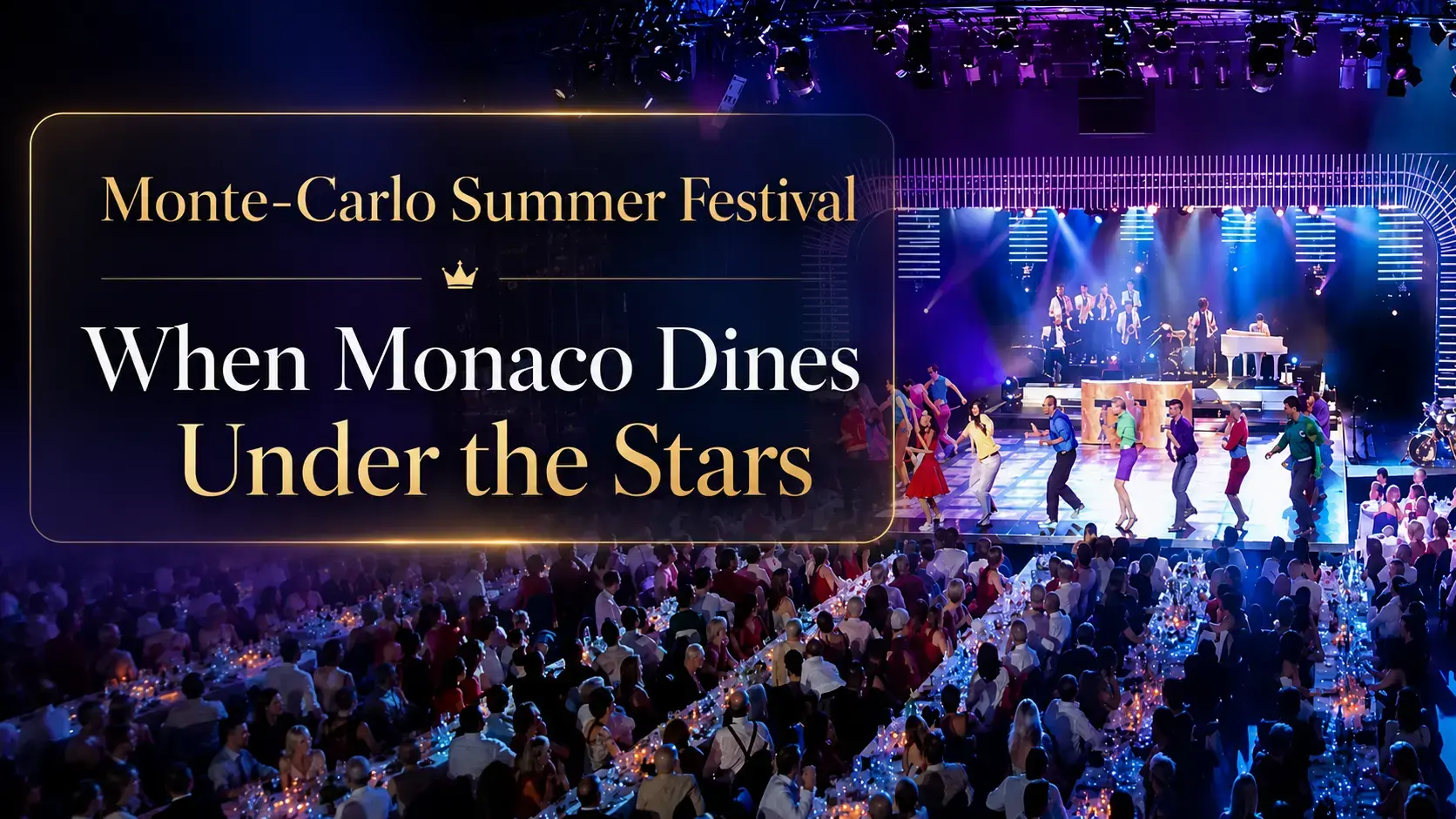
There is a moment during certain summer evenings in Monaco when the architecture itself seems to disappear. Dinner has already begun, the lights have softened, an international star is on stage — and above you, the roof of the Salle des Étoiles opens towards the Mediterranean sky.
Suddenly, you understand why Monaco never treated entertainment as something that simply happens inside a building.
Here, the setting is part of the performance.
The Monte-Carlo Summer Festival is one of the clearest expressions of that philosophy. Every July and August, international artists arrive in the Principality for a series of concerts held principally at the legendary Salle des Étoiles and the Opéra Garnier Monte-Carlo. In 2026, the programme began on 3 July, with the final evening scheduled for 15 August, when Laura Pausini closes the festival with a dinner show at the Salle des Étoiles. (Monte Carlo SBM)
But the festival becomes far more interesting when you discover the story behind the stage.
22 June 1974: The Night the Salle des Étoiles Was Born
Joséphine Baker inaugurated a venue that would become part of Monaco’s international mythology
The story takes us back to 22 June 1974.
That evening, the new Sporting Monte-Carlo opened with one of the most extraordinary personalities of the twentieth century: Joséphine Baker.
Dancer, singer, actress, Resistance figure and international celebrity, Baker was an ideal choice for Monaco. She represented glamour, courage and spectacle simultaneously.
The Salle des Étoiles that she inaugurated would later welcome performers including Whitney Houston, Elton John and Rihanna, becoming one of the Riviera’s legendary entertainment venues. (Célébrations Monte-Carlo Bay)
Its position is already theatrical. The Sporting Monte-Carlo stands beside the Mediterranean in Larvotto, away from the Belle Époque architecture surrounding the Casino.
Here Monaco presents another face: modern, nocturnal and almost entirely oriented towards the sea.
And then there is the roof.
The Salle des Étoiles was created so that its vast ceiling could retract, transforming an indoor gala into an evening beneath the real stars.
It is difficult to imagine a more Monegasque architectural gesture.
Monaco Had Been Building Stages Long Before the Festival
The Summer Festival belongs to a much older strategy of turning culture into identity
To understand why such a venue exists, look at Monaco in the nineteenth century.
When François Blanc transformed Monte-Carlo during the reign of Prince Charles III, the Principality was not simply building a casino. It was creating a destination.
Visitors needed hotels, gardens, restaurants, theatres, orchestras and experiences.
The Opéra de Monte-Carlo, designed by Charles Garnier and inaugurated in 1879, became one of the most spectacular symbols of that ambition.
By the twentieth century, Monaco understood something that many destinations would learn much later: people rarely travel for one monument alone. They travel for atmosphere.
The Summer Festival continues precisely that tradition.
Its modern form was devised in 2006 under Jean-René Palacio, then artistic director of Monte-Carlo Société des Bains de Mer. Palacio was also behind the creation of the Monte-Carlo Jazz Festival that same year. (Monte Carlo SBM)
The principle was simple: bring leading international musicians to Monaco, but allow the performances to remain unmistakably Monte-Carlo.
A Concert Where Dinner Is Part of the Performance
The evening begins long before the artist walks onto the stage
One of the most charming aspects of the festival is that certain Salle des Étoiles performances remain dinner shows.
For Jason Derulo’s 2026 appearance, for example, the official programme scheduled dinner for 8:30 p.m. and the concert for 10:30 p.m. (Monte Carlo SBM)
This changes the rhythm of the evening completely.
You do not rush through security and search for your seat while the opening act is beginning.
You arrive.
You are shown to a table.
Dinner is served.
Conversation continues.
Outside the windows, daylight slowly leaves the Mediterranean.
Only later does the concert begin.
During private excursions, I often explain that this is one of the secrets of old Monte-Carlo: luxury here was traditionally not about speed, but about ceremony.
Even entertainment needed an entrance.
A small detail that explains the name
Many visitors hear “Salle des Étoiles” — Hall of Stars — and assume it simply refers to famous performers.
But there is another, much more poetic interpretation.
When the roof opens above the audience, the stars are literally there.
It is one of those rare cases where architecture turns the name of a room into an experience.
The Stars of Summer 2026
Pop, soul, rock and French music share the same Monaco stages
The 2026 edition again demonstrates how broad the festival has become.
The programme includes artists and productions at both the Salle des Étoiles and Opéra Garnier, with Jason Derulo on 8 July, LP on 1 August, Lisa Stansfield on 11 August, Vanessa Paradis at the Opéra Garnier on 31 July, and several performances of Soul! between late July and early August. (Monte Carlo SBM)
The festival therefore does not try to impose one musical identity.
Its identity is Monaco itself.
The artist changes.
The audience changes.
The evening changes.
But the setting remains recognisable.
Two Monacos in One Evening
From Casino Square to Larvotto, you can travel through more than a century of Riviera history in a few kilometres
If you attend the festival, I recommend arriving in Monaco well before the concert.
Begin around Place du Casino.
Look at the Hôtel de Paris, the Casino de Monte-Carlo and the Opéra Garnier. This is the Monaco constructed during the great nineteenth-century transformation of the Principality.
Then move towards Larvotto and the Sporting.
The atmosphere changes.
The architecture becomes more contemporary. The Mediterranean becomes more present. Monte-Carlo shifts from Belle Époque grandeur to the language of beach clubs, terraces and nightlife.
Many guests are surprised when they realise how many different versions of Monaco exist within such a tiny territory.
This contrast is also something we explore on our private Monaco and French Riviera excursions, where Monaco can be combined naturally with Èze, the panoramic Corniche roads and other places that explain how the Principality fits into the wider history of the Côte d’Azur.
Visitors arriving by cruise ship can discover the same story through our private shore excursions, with the route adapted to the available time in port.
The Festival Is Also a Social Ritual
Look around the room as carefully as you look towards the stage
There is another aspect of the Monte-Carlo Summer Festival that rarely appears in concert listings.
The audience is part of the evening.
Monaco has always been a place where social observation is almost a discreet local sport.
People arrive from hotels, yachts and private residences. Evening clothes replace beachwear. Languages mix around the tables.
For a few hours, the Salle des Étoiles recreates something increasingly rare in Europe: the great summer gala.
Not exactly a nightclub.
Not exactly a theatre.
Not exactly a restaurant.
Something between all three.
And perhaps that is why the concept has survived.
When Is the Best Time to Experience It?
Arrive before sunset and allow Monaco to change around you
The best way to experience a Summer Festival evening is not to treat it simply as a concert reservation.
Give yourself time.
Visit Monaco in the late afternoon, when the intensity of the summer sun begins to fade. Walk around Casino Square while the façades still catch the light. Continue towards Larvotto before dinner.
Then let the evening take over.
For the latest programme, practical details and individual concert information, the official Monte-Carlo Société des Bains de Mer Summer Festival page remains the essential reference. (Monte Carlo SBM)
Why the Monte-Carlo Summer Festival Matters
Because Monaco has spent more than 150 years perfecting the art of the memorable evening
Monaco is often described through numbers: property prices, yacht lengths, casino tables, Formula 1 speeds.
But numbers explain very little about why the place became legendary.
The real story of Monte-Carlo is the creation of experiences.
A theatre beside a casino.
A grand hotel facing gardens.
A Formula 1 circuit running through city streets.
And a concert hall where the roof opens onto the Mediterranean sky.
The Monte-Carlo Summer Festival belongs to that same tradition.
It is not only about seeing a famous performer.
It is about understanding how Monaco has learned, generation after generation, to transform a simple evening into a spectacle.
And sometimes, while exploring the French Riviera, these are the moments that tell you more about a destination than any monument ever could.
If you would like to discover even more unexpected stories of Nice and the French Riviera, see places that rarely appear on standard itineraries, and connect them into a single historical picture, we invite you to join one of our private tours.
👉 Followу the link, choose any excursion from our collection and set out to explore the French Riviera more deeply — attentively, intellectually, and through a lively conversation about its past and present.
Suddenly, you understand why Monaco never treated entertainment as something that simply happens inside a building.
Here, the setting is part of the performance.
The Monte-Carlo Summer Festival is one of the clearest expressions of that philosophy. Every July and August, international artists arrive in the Principality for a series of concerts held principally at the legendary Salle des Étoiles and the Opéra Garnier Monte-Carlo. In 2026, the programme began on 3 July, with the final evening scheduled for 15 August, when Laura Pausini closes the festival with a dinner show at the Salle des Étoiles. (Monte Carlo SBM)
But the festival becomes far more interesting when you discover the story behind the stage.
22 June 1974: The Night the Salle des Étoiles Was Born
Joséphine Baker inaugurated a venue that would become part of Monaco’s international mythology
The story takes us back to 22 June 1974.
That evening, the new Sporting Monte-Carlo opened with one of the most extraordinary personalities of the twentieth century: Joséphine Baker.
Dancer, singer, actress, Resistance figure and international celebrity, Baker was an ideal choice for Monaco. She represented glamour, courage and spectacle simultaneously.
The Salle des Étoiles that she inaugurated would later welcome performers including Whitney Houston, Elton John and Rihanna, becoming one of the Riviera’s legendary entertainment venues. (Célébrations Monte-Carlo Bay)
Its position is already theatrical. The Sporting Monte-Carlo stands beside the Mediterranean in Larvotto, away from the Belle Époque architecture surrounding the Casino.
Here Monaco presents another face: modern, nocturnal and almost entirely oriented towards the sea.
And then there is the roof.
The Salle des Étoiles was created so that its vast ceiling could retract, transforming an indoor gala into an evening beneath the real stars.
It is difficult to imagine a more Monegasque architectural gesture.
Monaco Had Been Building Stages Long Before the Festival
The Summer Festival belongs to a much older strategy of turning culture into identity
To understand why such a venue exists, look at Monaco in the nineteenth century.
When François Blanc transformed Monte-Carlo during the reign of Prince Charles III, the Principality was not simply building a casino. It was creating a destination.
Visitors needed hotels, gardens, restaurants, theatres, orchestras and experiences.
The Opéra de Monte-Carlo, designed by Charles Garnier and inaugurated in 1879, became one of the most spectacular symbols of that ambition.
By the twentieth century, Monaco understood something that many destinations would learn much later: people rarely travel for one monument alone. They travel for atmosphere.
The Summer Festival continues precisely that tradition.
Its modern form was devised in 2006 under Jean-René Palacio, then artistic director of Monte-Carlo Société des Bains de Mer. Palacio was also behind the creation of the Monte-Carlo Jazz Festival that same year. (Monte Carlo SBM)
The principle was simple: bring leading international musicians to Monaco, but allow the performances to remain unmistakably Monte-Carlo.
A Concert Where Dinner Is Part of the Performance
The evening begins long before the artist walks onto the stage
One of the most charming aspects of the festival is that certain Salle des Étoiles performances remain dinner shows.
For Jason Derulo’s 2026 appearance, for example, the official programme scheduled dinner for 8:30 p.m. and the concert for 10:30 p.m. (Monte Carlo SBM)
This changes the rhythm of the evening completely.
You do not rush through security and search for your seat while the opening act is beginning.
You arrive.
You are shown to a table.
Dinner is served.
Conversation continues.
Outside the windows, daylight slowly leaves the Mediterranean.
Only later does the concert begin.
During private excursions, I often explain that this is one of the secrets of old Monte-Carlo: luxury here was traditionally not about speed, but about ceremony.
Even entertainment needed an entrance.
A small detail that explains the name
Many visitors hear “Salle des Étoiles” — Hall of Stars — and assume it simply refers to famous performers.
But there is another, much more poetic interpretation.
When the roof opens above the audience, the stars are literally there.
It is one of those rare cases where architecture turns the name of a room into an experience.
The Stars of Summer 2026
Pop, soul, rock and French music share the same Monaco stages
The 2026 edition again demonstrates how broad the festival has become.
The programme includes artists and productions at both the Salle des Étoiles and Opéra Garnier, with Jason Derulo on 8 July, LP on 1 August, Lisa Stansfield on 11 August, Vanessa Paradis at the Opéra Garnier on 31 July, and several performances of Soul! between late July and early August. (Monte Carlo SBM)
The festival therefore does not try to impose one musical identity.
Its identity is Monaco itself.
The artist changes.
The audience changes.
The evening changes.
But the setting remains recognisable.
Two Monacos in One Evening
From Casino Square to Larvotto, you can travel through more than a century of Riviera history in a few kilometres
If you attend the festival, I recommend arriving in Monaco well before the concert.
Begin around Place du Casino.
Look at the Hôtel de Paris, the Casino de Monte-Carlo and the Opéra Garnier. This is the Monaco constructed during the great nineteenth-century transformation of the Principality.
Then move towards Larvotto and the Sporting.
The atmosphere changes.
The architecture becomes more contemporary. The Mediterranean becomes more present. Monte-Carlo shifts from Belle Époque grandeur to the language of beach clubs, terraces and nightlife.
Many guests are surprised when they realise how many different versions of Monaco exist within such a tiny territory.
This contrast is also something we explore on our private Monaco and French Riviera excursions, where Monaco can be combined naturally with Èze, the panoramic Corniche roads and other places that explain how the Principality fits into the wider history of the Côte d’Azur.
Visitors arriving by cruise ship can discover the same story through our private shore excursions, with the route adapted to the available time in port.
The Festival Is Also a Social Ritual
Look around the room as carefully as you look towards the stage
There is another aspect of the Monte-Carlo Summer Festival that rarely appears in concert listings.
The audience is part of the evening.
Monaco has always been a place where social observation is almost a discreet local sport.
People arrive from hotels, yachts and private residences. Evening clothes replace beachwear. Languages mix around the tables.
For a few hours, the Salle des Étoiles recreates something increasingly rare in Europe: the great summer gala.
Not exactly a nightclub.
Not exactly a theatre.
Not exactly a restaurant.
Something between all three.
And perhaps that is why the concept has survived.
When Is the Best Time to Experience It?
Arrive before sunset and allow Monaco to change around you
The best way to experience a Summer Festival evening is not to treat it simply as a concert reservation.
Give yourself time.
Visit Monaco in the late afternoon, when the intensity of the summer sun begins to fade. Walk around Casino Square while the façades still catch the light. Continue towards Larvotto before dinner.
Then let the evening take over.
For the latest programme, practical details and individual concert information, the official Monte-Carlo Société des Bains de Mer Summer Festival page remains the essential reference. (Monte Carlo SBM)
Why the Monte-Carlo Summer Festival Matters
Because Monaco has spent more than 150 years perfecting the art of the memorable evening
Monaco is often described through numbers: property prices, yacht lengths, casino tables, Formula 1 speeds.
But numbers explain very little about why the place became legendary.
The real story of Monte-Carlo is the creation of experiences.
A theatre beside a casino.
A grand hotel facing gardens.
A Formula 1 circuit running through city streets.
And a concert hall where the roof opens onto the Mediterranean sky.
The Monte-Carlo Summer Festival belongs to that same tradition.
It is not only about seeing a famous performer.
It is about understanding how Monaco has learned, generation after generation, to transform a simple evening into a spectacle.
And sometimes, while exploring the French Riviera, these are the moments that tell you more about a destination than any monument ever could.
If you would like to discover even more unexpected stories of Nice and the French Riviera, see places that rarely appear on standard itineraries, and connect them into a single historical picture, we invite you to join one of our private tours.
👉 Followу the link, choose any excursion from our collection and set out to explore the French Riviera more deeply — attentively, intellectually, and through a lively conversation about its past and present.